Should You Change Your TSP or 457(b) When Gas Prices Rise, Tariffs Shift, and Markets Hit Record Highs?
 | |||
How OPEC, Tariffs, and Record Highs Intersect with Long-Term InvestingMay 14, 2026  | |||
Throughout much of stock market history, investing centered primarily on the selection of individual stocks and bonds. Over recent decades, however, macroeconomic developments have come to exert an increasing influence on financial markets. Major events — whether tied to central bank decisions, geopolitical tensions, or shifts in global trade — now have the potential to affect virtually all equities, irrespective of company-specific fundamentals. For investors, this reality means that constructing modern portfolios is less about identifying individual opportunities and more about making asset allocation decisions that align with long-term financial objectives.
This dynamic has been clearly evident over the past year and a half, during which two major macroeconomic forces have dominated: the war in Iran and U.S. tariff policy. Although these are distinct issues, both have consequences for consumer prices and business demand — one through elevated energy costs, the other through the price of imported goods. A defining characteristic of these macro-driven events, however, is that their effects tend to diminish over time. It is therefore essential for investors to maintain focus on longer-term trends and resist the urge to make portfolio adjustments in response to any single event.
The conflict in the Middle East, gasoline prices, and OPEC’s shifting role
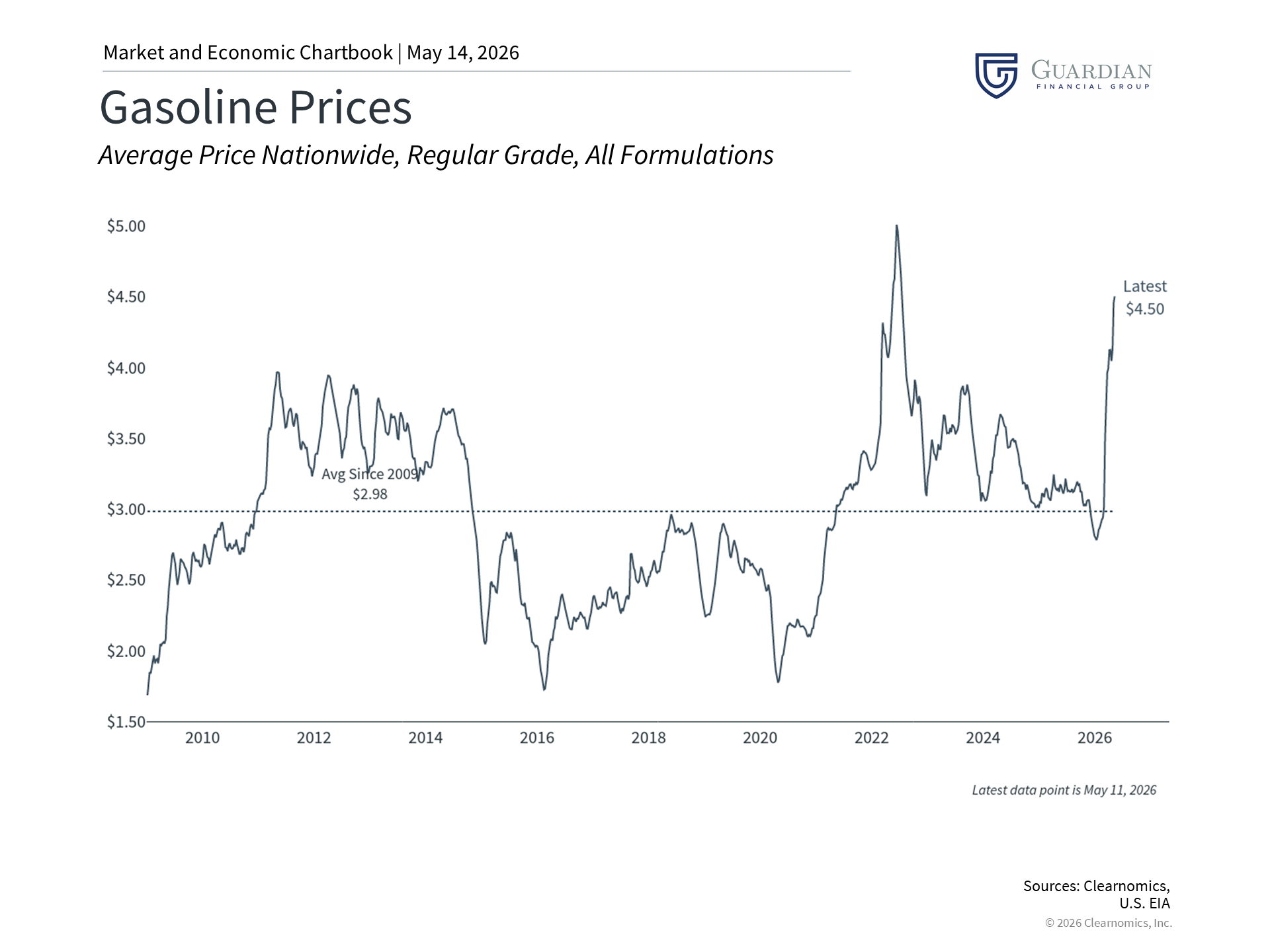
One of the most tangible ways the conflict in Iran has reached American households is through the price of gasoline. The national average for regular unleaded has risen to approximately $4.50 per gallon, well above the long-term average and a notable increase from levels seen just months ago. In certain regions, prices have already surpassed $6 per gallon.1 Because energy costs directly feed into the Consumer Price Index, headline inflation has moved higher, complicating an economic picture that had been on an improving trajectory.
For some observers, this environment recalls the 1970s Arab Oil Embargo, when supply shocks drove inflation sharply higher and led to gasoline rationing. However, the global energy landscape has changed substantially since that era. Notably, the U.S. is now the world’s largest energy producer, generating more than 13 million barrels of oil per day — a development that has significantly reduced the domestic economy’s sensitivity to global oil disruptions.
The recent decision by the United Arab Emirates (UAE) to exit OPEC further underscores how the global energy picture has evolved. For decades, OPEC members held a central role in setting world oil prices, primarily by agreeing on production quotas — a process that has always been difficult to achieve and verify across roughly a dozen nations. In particular, preventing member countries from exceeding their agreed-upon production limits has been an ongoing challenge.
The UAE’s departure illustrates how the cartel’s relevance has diminished as member nations pursue independent national strategies and expand their own production capacities. At its height in the 1970s, OPEC accounted for at least half of global oil supply. That share has since fallen to closer to one-third.2 The broader OPEC+ grouping — which includes Russia and other producers — was formed in part to compensate for this decline, but faces the same coordination difficulties.
The declining influence of OPEC does not eliminate the risk of oil price spikes during periods of geopolitical tension, but it does suggest that prices are somewhat less susceptible to OPEC’s decisions than they once were. While this offers limited relief to households whose budgets are strained by higher fuel costs, it does help explain why the broader market impact has not been more severe.
Tariff policy continues to be shaped by ongoing legal proceedings
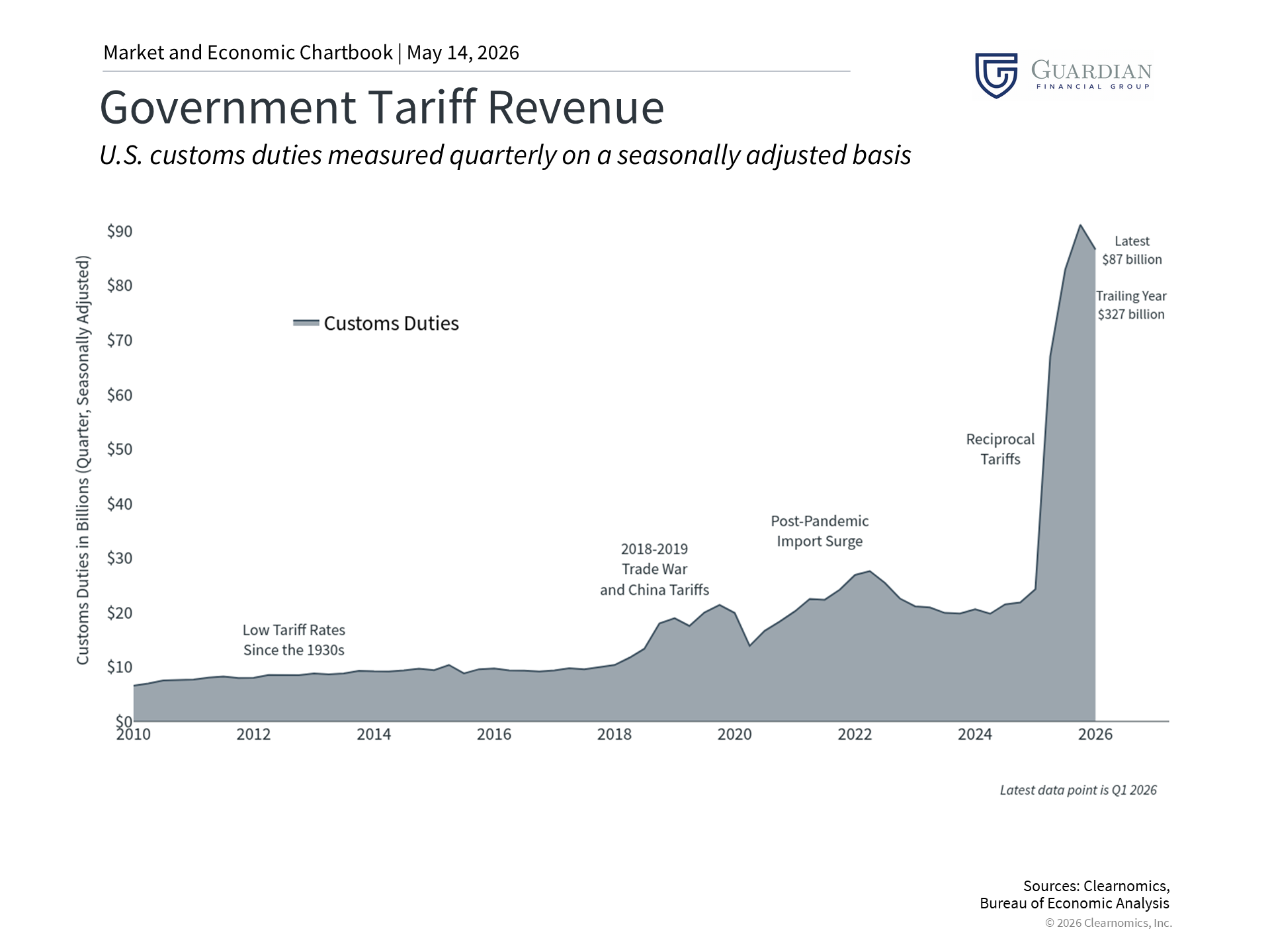
The second major macroeconomic driver has been tariff policy, which has continued to face significant legal scrutiny. In February, the Supreme Court ruled that tariffs implemented last April under the International Emergency Economic Powers Act (IEEPA) are illegal.3 In response, the administration shifted to relying on what is known as Section 122 of the Trade Act of 1974. More recently, the U.S. Court of International Trade ruled that these Section 122 tariffs are also unlawful.4
On one side of the equation, the administration remains committed to tariffs as a central element of its geopolitical strategy and retains other legal avenues to pursue them. Among these is Section 301 of the Trade Act of 1974, which permits tariffs following formal investigations into specific countries’ trade practices. Investigations of this kind have already been initiated against dozens of countries, suggesting that tariffs will likely persist, albeit in the form of country-specific rates.
On the other side, the process of refunding previously collected tariffs is now underway. Customs and Border Protection has begun processing refund claims, and some importers have already started receiving payments.5 Estimates suggest that total refunds could amount to between $160 and $170 billion.
Although the full scope and timeline of these refunds remains uncertain, any amounts returned could provide a meaningful boost to earnings and cash flow for affected importers. From a strictly economic standpoint, this represents the return of funds that were previously collected rather than a genuine new gain. That said, the outcome remains a positive development for both businesses and consumers.
Equity markets have climbed to new all-time highs in the face of ongoing uncertainty
For investors, the prevalence of macro-driven events means that broad market indices and individual stocks can experience significant swings tied to developments that have little bearing on any specific company’s underlying performance. Yet another consistent characteristic of such events is that their market impact tends to moderate over time. Headlines involving conflicts, energy prices, tariffs, and other issues can generate volatility, but they rarely prove to be the decisive factors in determining long-term investment outcomes.
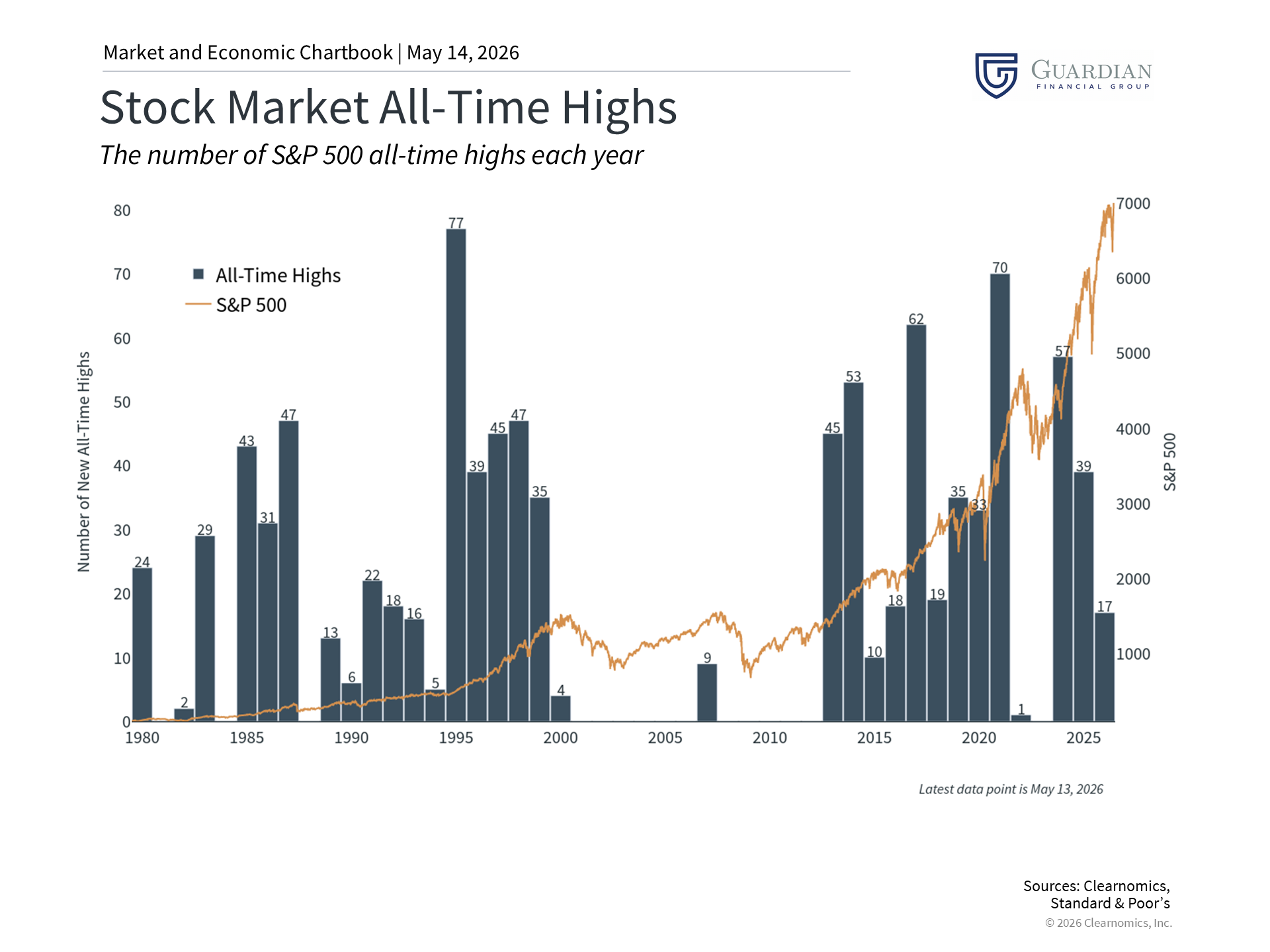
This is reflected in the fact that, despite the considerable uncertainty of the past year and a half, the S&P 500 has still registered more than a dozen new all-time highs so far this year. As the accompanying chart illustrates, achieving new all-time highs is a normal feature of bull markets, even amid a persistent flow of investor concerns. What ultimately matters is the broader foundation of corporate earnings and economic growth, both of which have remained on solid footing.
The bottom line? Today’s market environment is shaped by global forces that tend to come and go. Staying invested with a well-constructed portfolio remains the best way to navigate uncertainty and achieve long-term financial goals.
References 1. https://gasprices.aaa.com 2. https://www.eia.gov/international/content/analysis/special_topics/Global_Surplus_Crude_Oil_Production_Capacity/full-report.pdf 3. https://www.congress.gov/crs-product/LSB11398 4. https://www.cit.uscourts.gov/sites/cit/files/26-47.pdf 5. https://www.cbp.gov/trade/programs-administration/trade-remedies/ieepa-duty-refunds
Index Description The Standard & Poor’s 500 Index is a capitalization-weighted index of 500 stocks designed to measure performance of the broad domestic economy through changes in the aggregate market value of 500 stocks representing all major industries. | |||
Advisory services through Cambridge Investment Research Advisors, Inc., a Registered Investment Adviser. Cambridge and Guardian Financial Group are not affiliated. Copyright (c) 2026 Clearnomics, Inc. All rights reserved. The information contained herein has been obtained from sources believed to be reliable, but is not necessarily complete and its accuracy cannot be guaranteed. No representation or warranty, express or implied, is made as to the fairness, accuracy, completeness, or correctness of the information and opinions contained herein. The views and the other information provided are subject to change without notice. All reports posted on or via www.clearnomics.com or any affiliated websites, applications, or services are issued without regard to the specific investment objectives, financial situation, or particular needs of any specific recipient and are not to be construed as a solicitation or an offer to buy or sell any securities or related financial instruments. Past performance is not necessarily a guide to future results. Company fundamentals and earnings may be mentioned occasionally, but should not be construed as a recommendation to buy, sell, or hold the company's stock. Predictions, forecasts, and estimates for any and all markets should not be construed as recommendations to buy, sell, or hold any security--including mutual funds, futures contracts, and exchange traded funds, or any similar instruments. The text, images, and other materials contained or displayed in this report are proprietary to Clearnomics, Inc. and constitute valuable intellectual property. All unauthorized reproduction or other use of material from Clearnomics, Inc. shall be deemed willful infringement(s) of this copyright and other proprietary and intellectual property rights, including but not limited to, rights of privacy. Clearnomics, Inc. expressly reserves all rights in connection with its intellectual property, including without limitation the right to block the transfer of its products and services and/or to track usage thereof, through electronic tracking technology, and all other lawful means, now known or hereafter devised. Clearnomics, Inc. reserves the right, without further notice, to pursue to the fullest extent allowed by the law any and all criminal and civil remedies for the violation of its rights. |