Should You Sell During a 5% Market Pullback?
 | |||
How Portfolio Balance Helps Investors Navigate Market PullbacksMarch 16, 2026  | |||
Rising oil prices and ongoing geopolitical tensions have been the chief catalysts behind stock market turbulence in recent weeks. Brent crude oil has risen back above $100 per barrel, prompting concerns that elevated energy costs could simultaneously dampen economic growth and push inflation higher. These developments compound already-present uncertainties, including the influence of artificial intelligence on established businesses, broad market valuations, private credit markets, and the Federal Reserve's policy trajectory. Naturally, investors may find themselves questioning the health and resilience of their portfolios.
Alfred A. Montapert once wrote "do not confuse motion and progress." As markets experience daily swings in response to global headlines, there can be a natural impulse to frequently adjust portfolios and financial plans. Yet a fundamental principle of sound financial planning is that by the time uncertainty arrives, the groundwork should already be in place. A well-constructed portfolio holds an appropriate blend of complementary asset classes that are aligned with long-term financial goals—designed to endure a variety of market conditions without requiring constant recalibration.
Even so, directionless markets can feel unsettling. During periods like these, keeping a measured perspective is essential, particularly amid an abundance of negative headlines. Long-term goals should remain front and center, as disciplined saving and investing continue to be the most reliable paths to building wealth over time. What key considerations should investors keep in mind as uncertainty persists?
Market pullbacks are an unavoidable part of investing
Markets have been volatile this year, with the S&P 500 sitting approximately 5% below its all-time high reached in January, as of mid-March. Although recent market movements may feel unsettling, pullbacks of this magnitude are entirely normal. In a typical year, there are several declines of 5% or more that unfold over weeks or months before markets recover. In 2025, for instance, there were six such pullbacks for the S&P 500—driven largely by tariffs—yet the market still delivered a total return of 18% for the year.
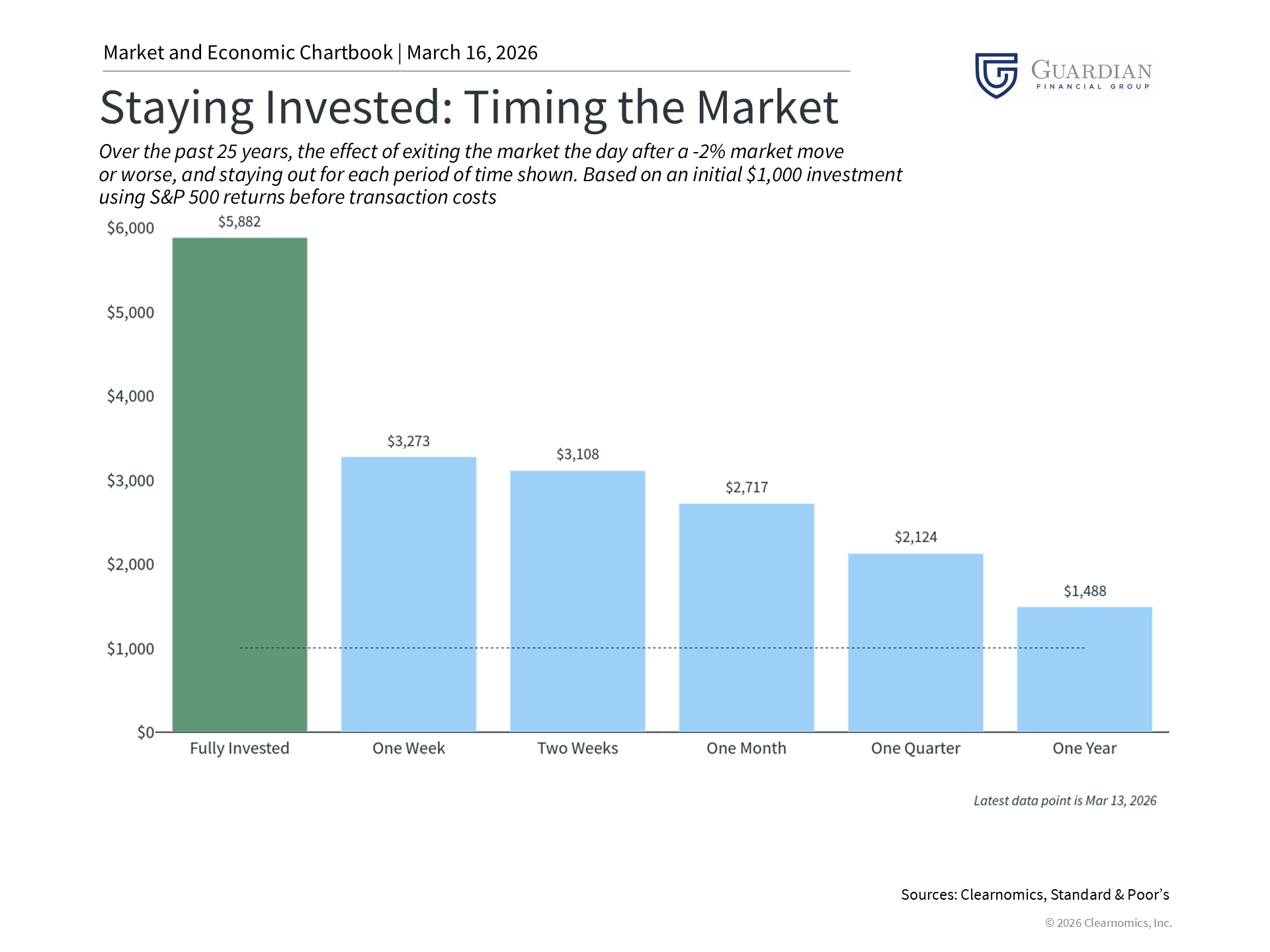
This underscores why remaining invested has historically proven to be the most effective strategy for long-term investors. While some may be tempted to time the market, the challenge lies not only in knowing when to exit but also in identifying when to re-enter. As the accompanying chart illustrates, even missing just one week following volatile sessions has historically produced negative outcomes for investors. This is largely because the market's strongest days have tended to occur shortly after its weakest ones. Those who moved to the sidelines often missed the very recoveries they were anticipating.
This is not to minimize the significance of pullbacks or suggest that markets always rebound swiftly. Rather, it is to recognize that pullbacks are a recurring feature of investing—one that should be planned for in advance, not reacted to in the moment.
Bond yields are attractive amid recent volatility
While equities tend to dominate financial headlines, the bond market is equally significant for investors. Inflation expectations are a key driver of bond performance, and the recent rise in oil prices has rekindled inflation concerns. Further uncertainty stems from the upcoming transition to a new Fed chair in May and questions about whether the central bank may alter its rate path. Current market-based measures anticipate only one rate cut by year-end.
Bonds serve as a core portfolio holding and often act as a counterbalance to stock market volatility. However, the geopolitical conflict in the Middle East has also affected fixed income markets, with the Bloomberg U.S. Aggregate Bond Index roughly flat year-to-date. The 10-year U.S. Treasury yield has climbed back above 4.2% after falling as low as 3.9% when the conflict in Iran escalated.
It is important to maintain perspective: following their historic selloff in 2022—when inflation and interest rates rose sharply—bonds have made meaningful contributions to portfolio returns, generating strong gains from 2023 to 2025. Since the October 2022 trough, the broad bond market has delivered approximately 20% in total returns, with certain individual sectors performing even more strongly.
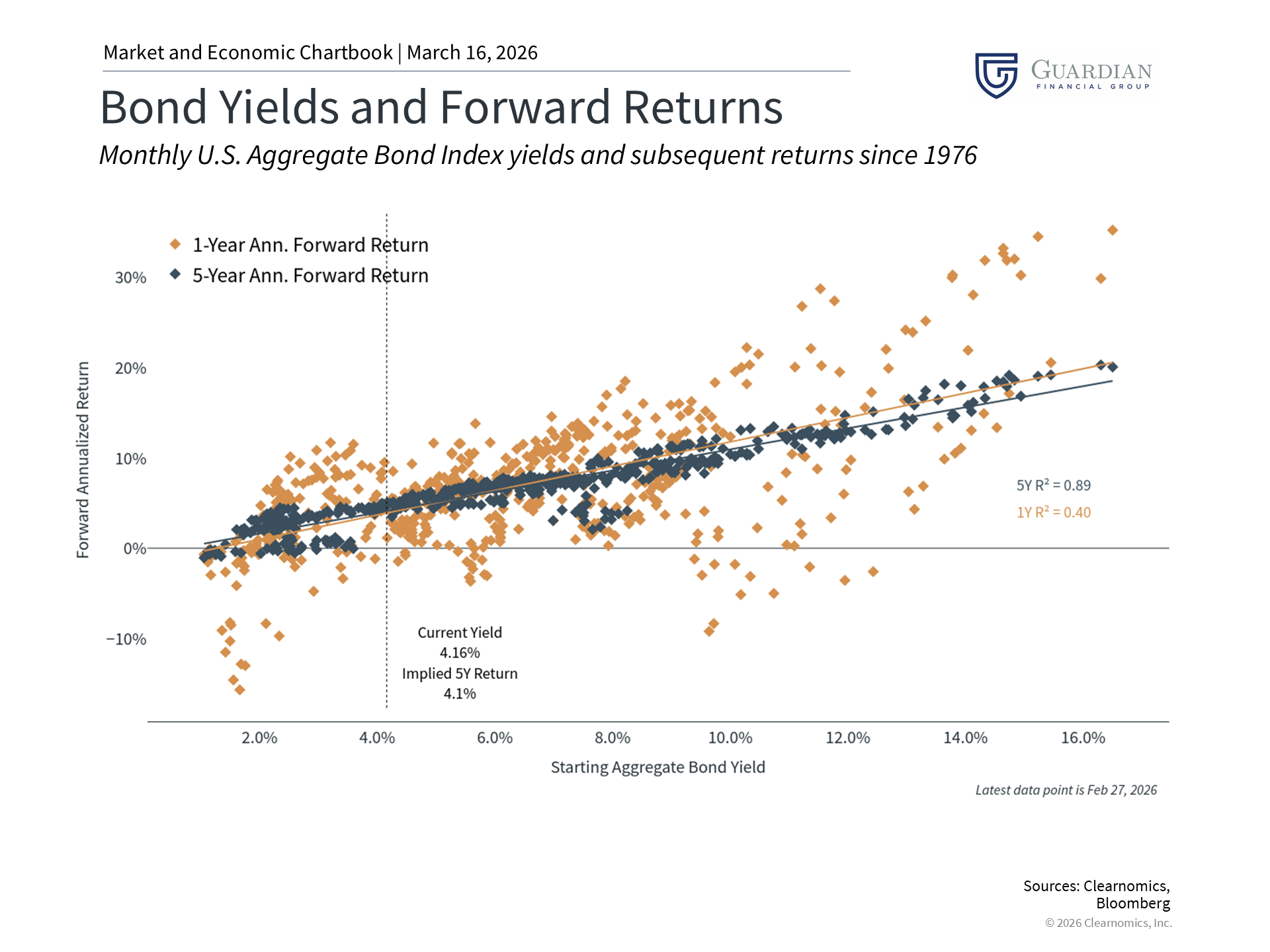
For long-term investors, bond yields remain compelling relative to the prior decade. Current yields offer meaningful income potential that was simply not available for much of the past ten years. The yield on the U.S. Aggregate Bond Index currently stands at 4.5%, well above its average of 2.9% since 2009. Historically, investing when yields are elevated has been associated with healthy total returns, as illustrated in the accompanying chart.
This is particularly noteworthy when compared to cash, where yields remain negative on an inflation-adjusted basis. On average, $10,000 invested in certificates of deposit yields approximately $155 per year—still well below inflation running between 2.5% and 3%. For investors in or approaching retirement, applicable inflation rates may be even higher due to medical expenses and insurance costs. While cash may feel like a safe haven, a thoughtful allocation to bonds remains the most effective way to generate income and support long-term portfolio growth.
It is also worth noting the growing attention on private credit, with reports of increasing redemption requests and some larger funds limiting withdrawals. At its core, private credit is an asset class comprised of non-bank loans to companies. The sector has expanded considerably in recent years and is linked to areas of market uncertainty such as technology and energy. Unlike publicly traded bonds, private credit is structured as a long-term investment precisely because of this inherent uncertainty. As with any asset class, what matters most for investors who hold private credit is whether it is appropriate for their specific portfolios and how it complements their other holdings.
Having a portfolio perspective continues to benefit investors
While each asset class carries its own set of considerations, recent market conditions underscore the value of a well-constructed portfolio. Holding a diverse mix of investments—spanning asset classes, sectors, and geographies—helps to smooth overall portfolio performance during turbulent periods, reducing the urge to make reactive decisions that can undermine long-term financial plans.
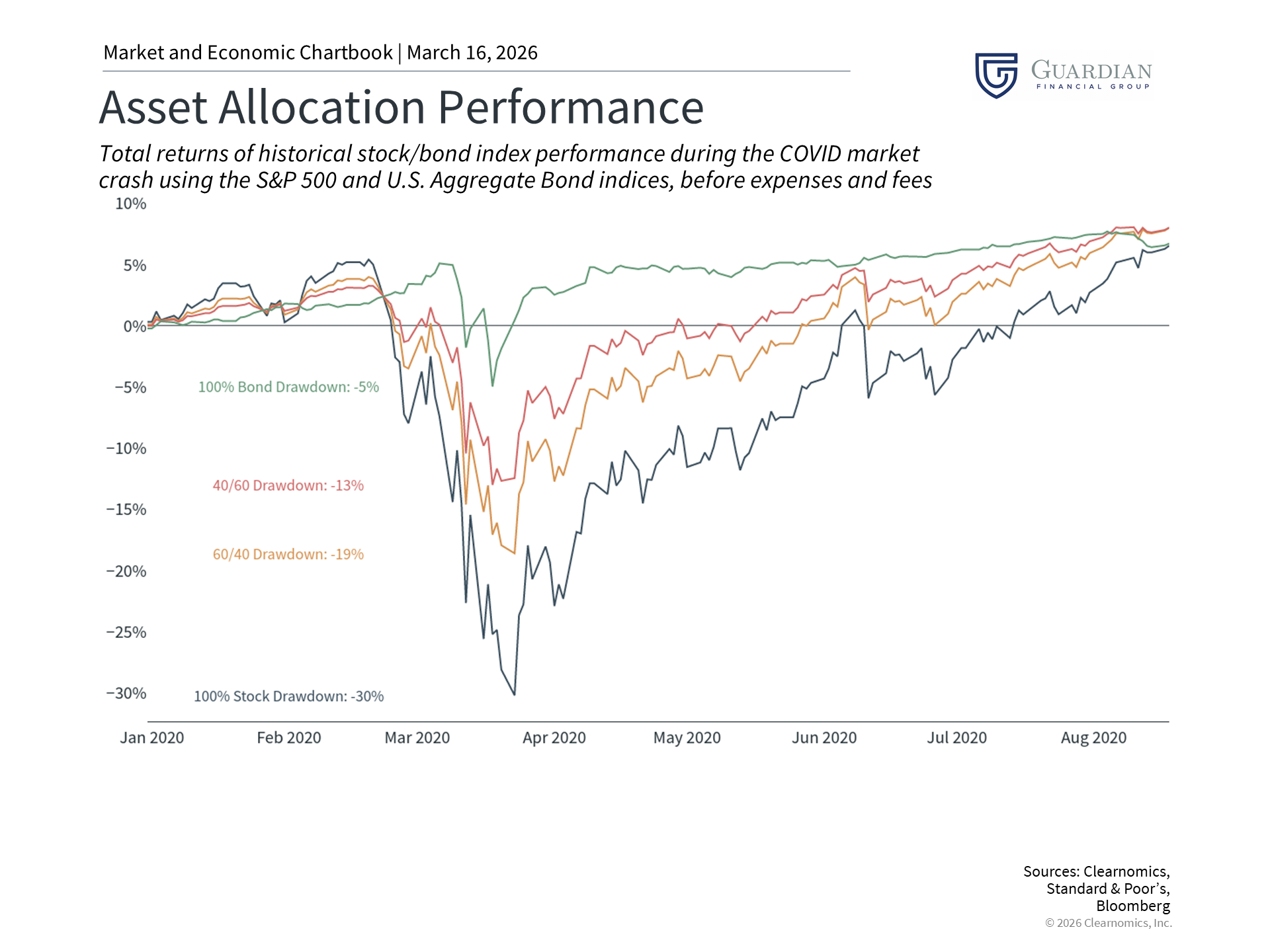
The accompanying chart highlights one of the most volatile stretches in modern history: the pandemic-driven market disruption in 2020. Different portfolio allocations responded in distinct ways, with those more evenly balanced across asset classes experiencing smaller swings. While these portfolios ultimately converged to similar levels following the episode, the key question is whether investors would have reacted impulsively when equities were down 20% or 30%.
Today, assets such as commodities are outperforming, buoyed by energy and precious metals. However, the goal is not to predict which asset class will lead next and concentrate a portfolio accordingly. Rather, it is about participating in the full spectrum of market movements. When one segment of a portfolio faces headwinds, another may provide stability. Over time, this balanced approach has enabled investors to pursue growth while managing risk—which is ultimately what achieving long-term financial objectives demands.
The bottom line? Market volatility driven by oil prices and geopolitical uncertainty is uncomfortable but not unusual. Staying invested with a diversified portfolio remains the best way to turn short-term swings into long-term progress. | |||
Advisory services through Cambridge Investment Research Advisors, Inc., a Registered Investment Adviser. Cambridge and Guardian Financial Group are not affiliated. Copyright (c) 2026 Clearnomics, Inc. All rights reserved. The information contained herein has been obtained from sources believed to be reliable, but is not necessarily complete and its accuracy cannot be guaranteed. No representation or warranty, express or implied, is made as to the fairness, accuracy, completeness, or correctness of the information and opinions contained herein. The views and the other information provided are subject to change without notice. All reports posted on or via www.clearnomics.com or any affiliated websites, applications, or services are issued without regard to the specific investment objectives, financial situation, or particular needs of any specific recipient and are not to be construed as a solicitation or an offer to buy or sell any securities or related financial instruments. Past performance is not necessarily a guide to future results. Company fundamentals and earnings may be mentioned occasionally, but should not be construed as a recommendation to buy, sell, or hold the company's stock. Predictions, forecasts, and estimates for any and all markets should not be construed as recommendations to buy, sell, or hold any security--including mutual funds, futures contracts, and exchange traded funds, or any similar instruments. The text, images, and other materials contained or displayed in this report are proprietary to Clearnomics, Inc. and constitute valuable intellectual property. All unauthorized reproduction or other use of material from Clearnomics, Inc. shall be deemed willful infringement(s) of this copyright and other proprietary and intellectual property rights, including but not limited to, rights of privacy. Clearnomics, Inc. expressly reserves all rights in connection with its intellectual property, including without limitation the right to block the transfer of its products and services and/or to track usage thereof, through electronic tracking technology, and all other lawful means, now known or hereafter devised. Clearnomics, Inc. reserves the right, without further notice, to pursue to the fullest extent allowed by the law any and all criminal and civil remedies for the violation of its rights. |