Why Did Gold Crash After Hitting $5,400 in January?
 | |||
January Market Review: Navigating Geopolitics, Fed Policy, and Precious MetalsFebruary 2, 2026  | |||
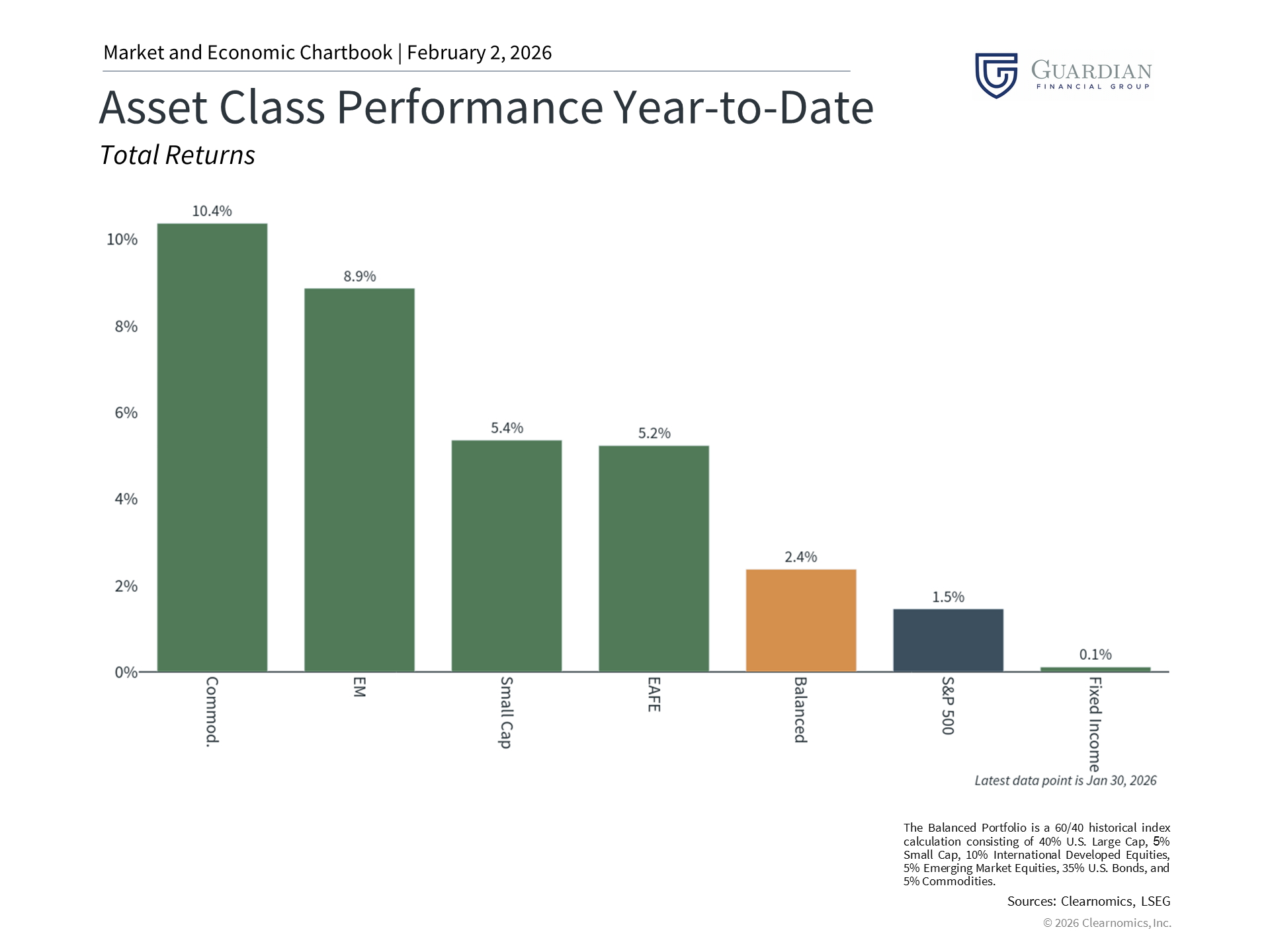
Stocks and bonds delivered positive returns to start the year, extending the momentum from previous years. Some investors may find this unexpected given multiple episodes of volatility sparked by geopolitical developments and Federal Reserve policy decisions. Although headlines triggered short-term market fluctuations, including the S&P 500's steepest decline since October of the prior year, markets recovered swiftly. Within a matter of days, major benchmarks established fresh all-time highs, supported in part by solid corporate earnings that have bolstered portfolios.
January offers long-term investors an important lesson: while headlines can drive markets in unexpected directions, underlying fundamentals and long-term planning remain paramount. Although geopolitical developments and policy ambiguity will probably generate additional volatility during 2026, the most effective approach to managing these challenges continues to be maintaining a balanced portfolio that aligns with your long-term financial objectives.
January's Principal Market and Economic Developments
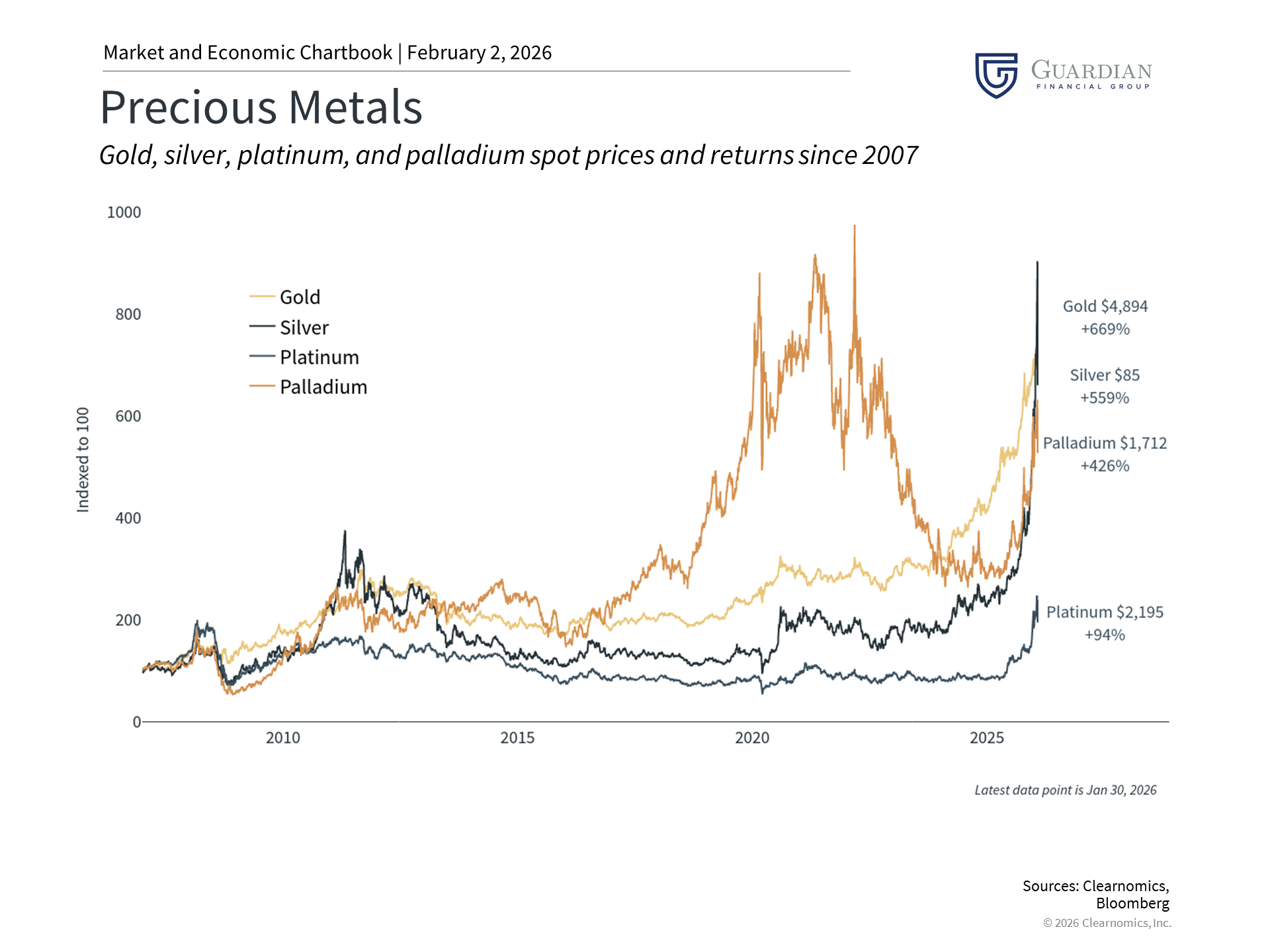
• The S&P 500 advanced 1.4% during January and momentarily exceeded 7,000 on an intraday basis for the first time. The Nasdaq Composite increased 0.9% and the Dow Jones Industrial Average rose 1.7%. • The CBOE VIX volatility index closed the month at 17.44 after climbing above 20 amid geopolitical concerns. • The Bloomberg U.S. Aggregate Bond Index edged up 0.1% during the month as longer-term interest rates increased. The 10-year Treasury yield finished the month at 4.24%, marking its highest level since September of the previous year. • International developed markets surged 5.2% in U.S. dollar terms according to the MSCI EAFE Index, while emerging markets rose 8.8% based on the MSCI EM Index. • President Trump named Kevin Warsh as his nominee for the next Fed Chair. Following Senate confirmation, he would assume the position in mid-May. • Gold climbed to a record closing price of $5,417 per ounce before dropping nearly 10% on January 30. • Silver similarly reached a closing high of $116.70 before declining sharply to end the month at $85.20. • The U.S. dollar index declined further to approximately 97.0, touching its lowest point in nearly four years, before recovering modestly after the Fed Chair announcement. • The Federal Reserve maintained its policy rate at 3.50 to 3.75% during its January meeting, after implementing three consecutive quarter-point reductions in the latter half of 2025. • Consumer Price Index inflation held steady at 2.7% year-over-year in December, remaining above the Fed's 2% objective. The Producer Price Index rose to 3.0%. • Washington concluded the month experiencing a partial government shutdown. • Harsh winter conditions throughout much of the Eastern and Southern United States triggered spikes in natural gas and electricity prices.
Geopolitical developments pushed market volatility higher
A U.S. operation in Venezuela early in the month led to the apprehension of Nicolás Maduro. Although the operation focused on narco-terrorism, discussion rapidly shifted to oil implications. Venezuela possesses the world's largest confirmed oil reserves yet produces less than 1% of global crude output owing to inadequate infrastructure. For investors, commodity prices serve as the principal mechanism through which geopolitical developments influence financial markets, with oil maintaining its central role in the global economy.
Geopolitical worries intensified following U.S. comments about acquiring Greenland based on its strategic significance for defense and natural resources. This triggered diplomatic friction with NATO partners involving tariffs that produced the S&P 500's sharpest decline since October of the previous year. Nevertheless, the situation de-escalated rapidly after President Trump convened with the NATO secretary general and outlined a "framework of a future deal," prompting the market to recover.
For long-term investors, geopolitical developments may generate near-term uncertainty, but historical evidence indicates that their impact on markets and the economy is frequently exaggerated. Markets have generally recovered as initial concerns subside. Investors should refrain from overreacting to news flow and instead preserve a long-term concentration on financial objectives.
Fed uncertainty influenced gold, silver, and the dollar
Precious metals sustained their advance until a substantial reversal on January's final day. Gold climbed to nearly $5,600 on an intraday basis while silver's spot price surpassed $120 per ounce before both experienced sharp selloffs. These movements have resulted from multiple factors including geopolitical risk, central bank acquisitions, and worries about Federal Reserve independence.
The forces propelling gold and silver have been characterized as the "debasement trade," representing the notion that fiscal and monetary policies that effectively diminish the dollar, generate deficits, and produce inflation may bolster precious metals. Fed uncertainty, including speculation about whether a new Fed chair might pursue lower interest rates, has propelled these metals upward.
On January 30, however, President Trump revealed his plan to nominate Kevin Warsh as the next Fed Chair following Jerome Powell's term expiration in mid-May. Warsh is a former Fed governor who has recently expressed preference for lower interest rates. Nevertheless, he has previously taken hawkish positions, indicating he has supported maintaining higher rates to combat inflation. For investors, this modified expectations by suggesting a potentially smoother leadership transition at the Fed. This development triggered a sharp decline in both gold and silver, accompanied by a modest dollar appreciation.
This reversal highlights both the susceptibility of precious metals to boom-and-bust patterns and illustrates how rapidly markets can pivot based on policy expectations. While precious metals can benefit investors, their volatility throughout January illustrates why they should complement, rather than substitute for, core allocations in stocks and bonds.
Corporate earnings sustained strength amid uncertainty
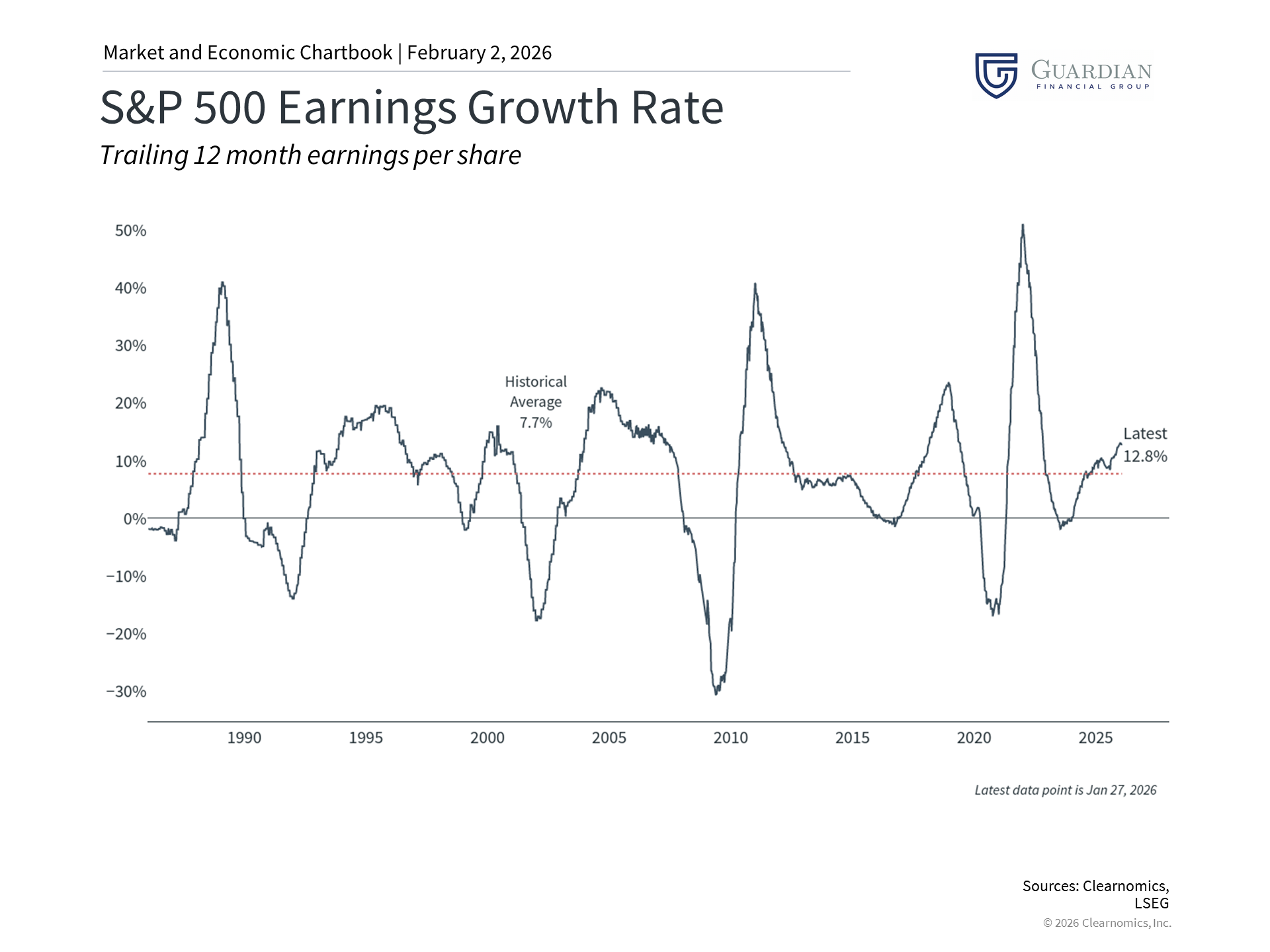
Beyond the prominent global headlines, fourth quarter earnings demonstrated that companies maintain solid performance. According to FactSet, 33% of S&P 500 companies have announced results with 75% exceeding expectations. Should these patterns persist, large public companies could achieve a growth rate of 11.9% for the quarter, marking the 5th consecutive quarter of double-digit earnings expansion. On a trailing 12-month basis, earnings growth has accelerated to 12.8% according to consensus forecasts.
Understandably, many investors concentrate on AI and technology earnings given these stocks have driven market returns during recent years. Thus far, markets have reacted variably to these companies' earnings, even when they surpass estimates, reflecting elevated expectations and questions regarding spending sustainability. Simultaneously, numerous other sectors have gained from broad economic expansion and have increased their earnings at accelerated rates as well.
For long-term investors, the fundamental message from earnings season is encouraging. Corporate profitability maintains strength across many sectors, underpinning stock valuations. This fundamental resilience explains why major indices remained positive for the month despite substantial volatility.
Harsh weather impacted much of the nation
January's harsh winter conditions, designated Winter Storm Fern, impacted at least 21 states and more than half the U.S. population. The storm necessitated state emergency declarations and created disruptions to economic operations, including power failures and thousands of flight cancellations.
While the welfare of those affected by the storm remains the paramount concern, historical evidence demonstrates that weather-related disruptions such as hurricanes and blizzards exert minimal long-term impact on the national economy. The critical distinction involves whether these events damage productive capacity such as factories, equipment, and businesses, or whether they merely defer activity. In this instance, temporary disruptions to sectors including retail and construction simply shift economic activity forward in time.
The bottom line? January featured market volatility stemming from geopolitics, the Fed, and other factors. Nevertheless, markets demonstrated resilience and strong corporate earnings have propelled major indices to fresh all-time highs, even as precious metals faltered. For long-term investors, this reinforces the significance of maintaining appropriate asset allocation that corresponds with financial objectives. | |||
Advisory services through Cambridge Investment Research Advisors, Inc., a Registered Investment Adviser. Cambridge and Guardian Financial Group are not affiliated. Copyright (c) 2026 Clearnomics, Inc. All rights reserved. The information contained herein has been obtained from sources believed to be reliable, but is not necessarily complete and its accuracy cannot be guaranteed. No representation or warranty, express or implied, is made as to the fairness, accuracy, completeness, or correctness of the information and opinions contained herein. The views and the other information provided are subject to change without notice. All reports posted on or via www.clearnomics.com or any affiliated websites, applications, or services are issued without regard to the specific investment objectives, financial situation, or particular needs of any specific recipient and are not to be construed as a solicitation or an offer to buy or sell any securities or related financial instruments. Past performance is not necessarily a guide to future results. Company fundamentals and earnings may be mentioned occasionally, but should not be construed as a recommendation to buy, sell, or hold the company's stock. Predictions, forecasts, and estimates for any and all markets should not be construed as recommendations to buy, sell, or hold any security--including mutual funds, futures contracts, and exchange traded funds, or any similar instruments. The text, images, and other materials contained or displayed in this report are proprietary to Clearnomics, Inc. and constitute valuable intellectual property. All unauthorized reproduction or other use of material from Clearnomics, Inc. shall be deemed willful infringement(s) of this copyright and other proprietary and intellectual property rights, including but not limited to, rights of privacy. Clearnomics, Inc. expressly reserves all rights in connection with its intellectual property, including without limitation the right to block the transfer of its products and services and/or to track usage thereof, through electronic tracking technology, and all other lawful means, now known or hereafter devised. Clearnomics, Inc. reserves the right, without further notice, to pursue to the fullest extent allowed by the law any and all criminal and civil remedies for the violation of its rights. |