Will the New Fed Chair Change Your Investment Strategy?
 | |||
Federal Reserve Leadership Transition: What Investors Should KnowDecember 15, 2025  | |||
The Federal Reserve serves a critical function in maintaining economic stability and supporting financial markets for long-term investors. This role takes on heightened significance in 2026 as Jerome Powell's tenure as Fed Chair concludes in May, presenting an opportunity for the administration to influence the central bank's leadership and strategic direction. These developments may affect interest rate policy, equity markets, and investment portfolios.
Media coverage frequently emphasizes upcoming rate decisions, yet substantial discussion among financial professionals and policymakers centers on defining the Fed's appropriate scope. The central bank's responsibilities have transformed over time in reaction to economic crises and cyclical patterns. For investors, this remains a subject of debate, with legitimate differences of opinion regarding the extent of the Fed's powers and appropriate policy actions concerning interest rates and monetary supply.
As 2026 approaches, these questions become increasingly relevant because they influence not only immediate policy choices but also the central bank's long-term trajectory. What information should investors consider as Fed-related news continues to dominate headlines?
The central bank's responsibilities have grown throughout its history
Congress created the Federal Reserve through the Federal Reserve Act of 1913, marking the nation's third attempt at establishing a central banking institution. The Fed operates independently from the federal government and was not originally outlined in the Constitution. Three fundamental concerns frequently arise regarding Fed independence: 1) its mandate has broadened considerably over the decades, 2) Fed policymakers are not chosen through direct elections, and 3) elected officials typically favor accommodative monetary policy to support job creation and economic expansion.
The Fed's original purpose focused on preventing banking panics when Congress first authorized its creation. Such crises occurred regularly during the 19th and early 20th centuries, creating significant hardships for businesses and ordinary citizens. Notable examples from this period include the Great Depression, along with the Panics of 1907 and 1893, among others. These crises frequently began or intensified when depositors lost faith in their banks and rushed to withdraw funds, endangering individual institutions and the wider financial infrastructure.
Although economic and financial difficulties persist, these specific types of banking panics occur less frequently in modern times. The Fed oversees bank capital requirements and, crucially, functions as the "lender of last resort." In this capacity, it provides a safety net during potential crisis situations. The Fed's demonstrated readiness to intervene helps maintain financial system stability and supports orderly market functioning. Recent examples include the 2020 pandemic response and the 2023 regional banking stress.
The Fed's mandate has expanded substantially since its founding. The Federal Reserve Reform Act of 1977, passed during a time of elevated inflation and joblessness, instructed the central bank to pursue "maximum employment, stable prices, and moderate long-term interest rates." The Fed generally concentrates on the first two objectives as its "dual mandate," viewing the third as a natural outcome of achieving the others.
This transformation is frequently characterized as "mission creep," as the Fed now oversees not just banking institutions, payment systems, and currency valuation, but also broader economic conditions. Whether justified or not, this explains the intense scrutiny surrounding each Federal Open Market Committee (FOMC) rate decision, both for the trajectory of rates and for insights into the Fed's economic outlook.
Central bank independence presents competing considerations
The president nominates Fed officials subject to congressional confirmation, but they are not chosen through popular vote. Skeptics contend that the Fed represents an unelected institution wielding significant economic influence over all Americans. Supporters maintain that the Fed must frequently implement unpopular measures, including policies that may temporarily constrain economic activity to sustain longer-term growth. Both perspectives contain merit, making it challenging to maintain an objective viewpoint.
The late 1970s and early 1980s often illustrate this tradeoff favorably. Throughout that period, economic disruptions and political pressure for loose monetary policy led to "stagflation," characterized by simultaneous high inflation and unemployment. Fed Chair Paul Volcker ultimately implemented aggressive rate increases, triggering a recession that ultimately ended the stagflationary cycle. This experience established the framework for an independent Fed in subsequent decades.
Naturally, the Fed lacks perfect foresight and occasionally errs in its judgments. Former Fed Chair Ben Bernanke acknowledged to economist Milton Friedman that "you're right, we did it" – acknowledging policy mistakes that exacerbated the Great Depression a century earlier. More recently, many market participants and economists felt the Fed responded too slowly to post-pandemic inflation emerging in 2021, necessitating abrupt rate increases.
Even with perfect information, the Fed's policy toolkit remains constrained. The Fed primarily manages short-term interest rates through the federal funds rate. This is commonly described as a "blunt instrument" because adjusting one policy rate cannot address many fundamental economic challenges. These include supply chain disruptions that began in 2020 and contributed to higher inflation, trade policy uncertainty, or potential workforce impacts from artificial intelligence.
Furthermore, the Fed can only indirectly affect longer-term rates, which carry greater significance for home mortgages, business financing, and capital investment choices. Market forces including inflation expectations, government fiscal policy, and economic growth determine these rates. Consequently, while the Fed is often perceived as controlling economic and financial conditions, it frequently influences markets or responds to events rather than directing them.
New leadership may influence policy trajectory in 2026 and thereafter
With Fed Chair Jerome Powell's term concluding shortly, the White House is anticipated to announce a successor in early 2026. Currently, leading candidates include Kevin Warsh, who previously served as a Fed governor, and Kevin Hassett, who directs the National Economic Council at the White House. Circumstances may evolve before a final selection is made, and the list of leading candidates has shifted within recent months.
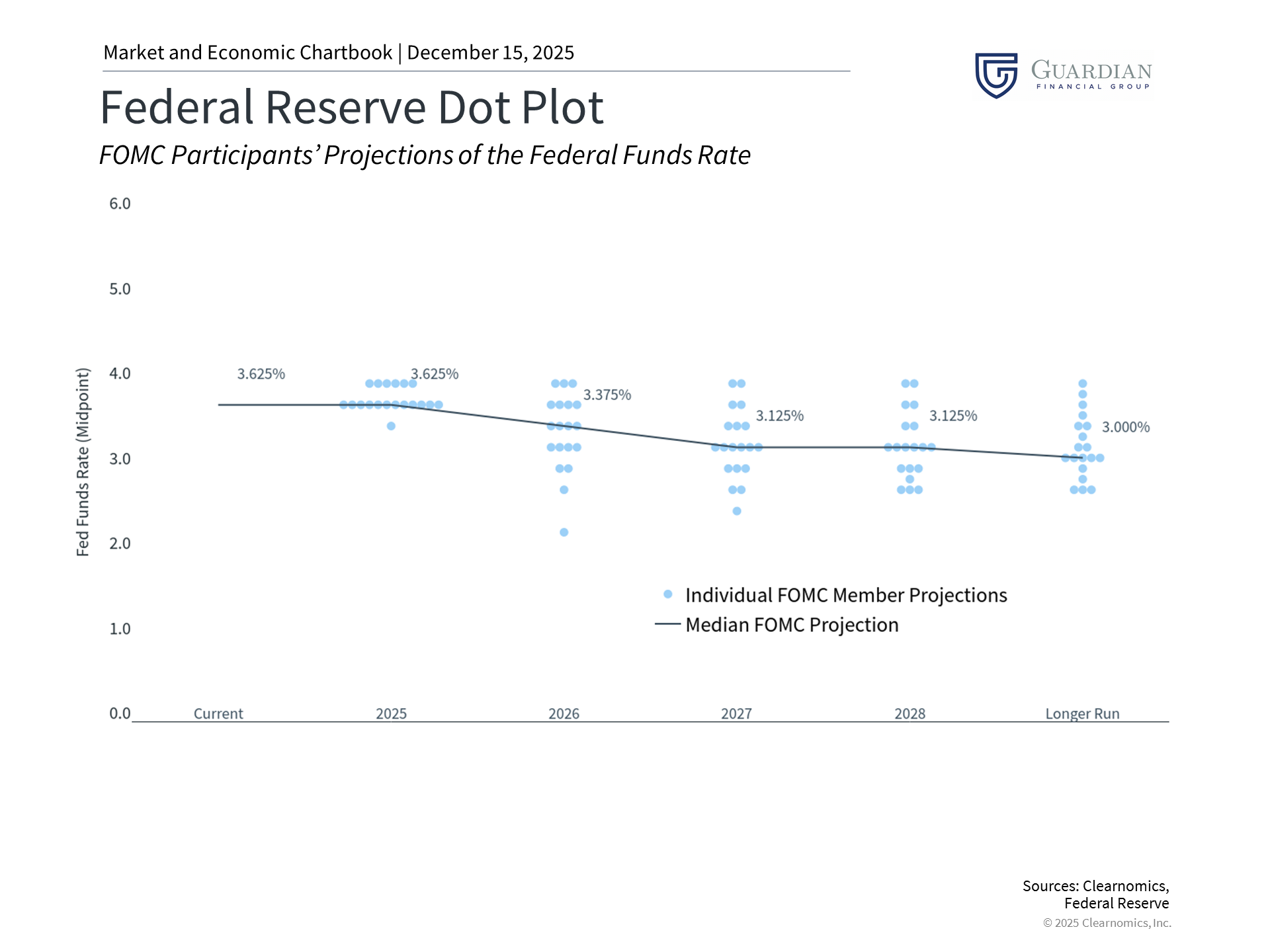
The chart above displays the FOMC's most recent Summary of Economic Projections. These estimates indicate the Fed may reduce rates just once in both 2026 and 2027. Irrespective of the next Fed Chair nominee's identity, the administration will likely select someone favorably disposed toward lower policy rates. These projections may therefore change in coming months.
Simultaneously, avoiding overreaction to potential policy shifts remains important. Although the Fed Chair influences policy direction and speaks for the FOMC at press conferences, the committee comprises twelve voting members with varying perspectives. This includes the New York Fed President, seven Fed governors, and four regional bank presidents who rotate voting rights annually. Historically, the Fed has sought consensus. Therefore, even a Chair sympathetic to the administration's policy preferences must persuade other committee members through economic reasoning and policy arguments.
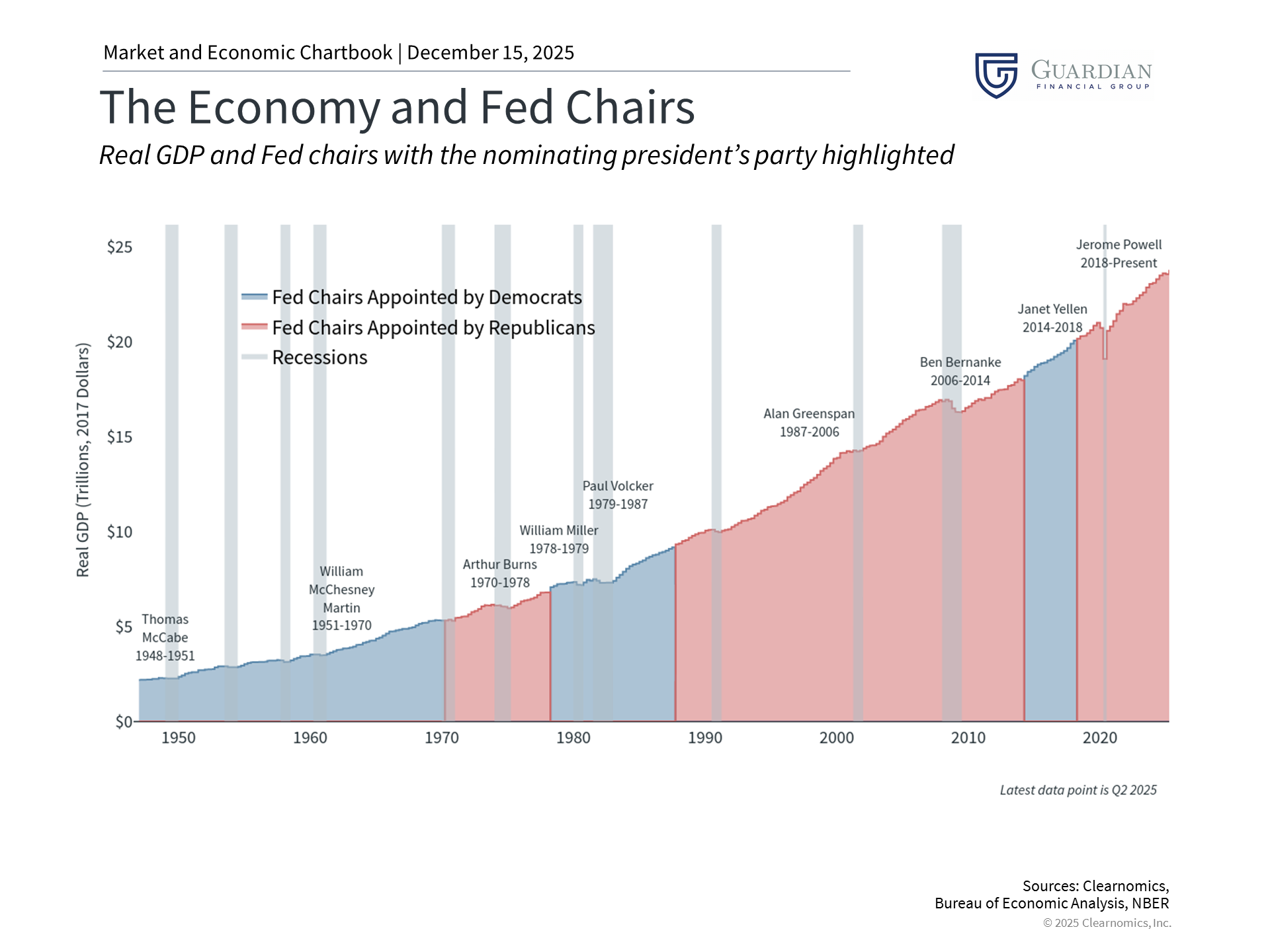
Maintaining broader perspective proves valuable since Fed leadership transitions are not unprecedented. The first chart above demonstrates that the economy has expanded consistently across different Fed Chairs appointed by both political parties. It's also worth noting that President Trump nominated Jerome Powell during his first term, and Powell continued as Fed Chair during President Biden's administration.
More important than any single Chair is whether monetary policy remains suitable for prevailing economic circumstances. Once again, the Fed frequently reacts to external shocks beyond its control, rather than directly guiding economic outcomes.
Broad economic conditions outweigh individual Fed policy decisions
While Fed leadership will generate numerous headlines in upcoming months, the economy's overall trajectory matters most. The incoming Fed Chair may generally favor lower interest rates, but this will depend heavily on labor market strength and whether inflation remains contained. For investors, maintaining a portfolio aligned with financial objectives rather than reacting to daily Fed speculation remains paramount.
The bottom line? Markets have historically delivered strong performance across various Fed Chairs and policy frameworks. For investors, maintaining focus on long-term economic trends remains the most effective path to achieving financial objectives. | |||
Advisory services through Cambridge Investment Research Advisors, Inc., a Registered Investment Adviser. Cambridge and Guardian Financial Group are not affiliated. Copyright (c) 2025 Clearnomics, Inc. All rights reserved. The information contained herein has been obtained from sources believed to be reliable, but is not necessarily complete and its accuracy cannot be guaranteed. No representation or warranty, express or implied, is made as to the fairness, accuracy, completeness, or correctness of the information and opinions contained herein. The views and the other information provided are subject to change without notice. All reports posted on or via www.clearnomics.com or any affiliated websites, applications, or services are issued without regard to the specific investment objectives, financial situation, or particular needs of any specific recipient and are not to be construed as a solicitation or an offer to buy or sell any securities or related financial instruments. Past performance is not necessarily a guide to future results. Company fundamentals and earnings may be mentioned occasionally, but should not be construed as a recommendation to buy, sell, or hold the company's stock. Predictions, forecasts, and estimates for any and all markets should not be construed as recommendations to buy, sell, or hold any security--including mutual funds, futures contracts, and exchange traded funds, or any similar instruments. The text, images, and other materials contained or displayed in this report are proprietary to Clearnomics, Inc. and constitute valuable intellectual property. All unauthorized reproduction or other use of material from Clearnomics, Inc. shall be deemed willful infringement(s) of this copyright and other proprietary and intellectual property rights, including but not limited to, rights of privacy. Clearnomics, Inc. expressly reserves all rights in connection with its intellectual property, including without limitation the right to block the transfer of its products and services and/or to track usage thereof, through electronic tracking technology, and all other lawful means, now known or hereafter devised. Clearnomics, Inc. reserves the right, without further notice, to pursue to the fullest extent allowed by the law any and all criminal and civil remedies for the violation of its rights. |